
• Zum Hauptinhalt springen
  • Zum Footer springen
  • LMU Munich
  • University Hospital

ISD Research

  • Our Labs
    • Dichgans Lab
    • Bernhagen Lab
    • Simons Lab
    • Liesz Lab
    • Ewers Lab
    • Paquet Lab
    • Plesnila Lab
    • Erturk Lab
    • Wahl Lab
    • Duering Lab
    • Benakis Lab
    • Franzmeier Lab
    • Georgakis Lab
    • Jäkel Lab
    • Spitzer Lab
    • Tiedt Lab
  • News
  • Publications
  • About us
    • How to get there
    • Scientific Advisory Board
    • Management
    • Media 
    • Diversity at the ISD
    • ISD Photos 
  • Support
  • Open positions
  • For Patients
  1. ISD Research
  2. News
  3. AI atlas reveals systemic-injury caused by obesity
News | 22/05/2026

AI atlas reveals systemic-injury caused by obesity

Ali Erturk and his team have developed an artificial intelligence (AI) framework that maps disease-related changes throughout the entire mouse body at cellular resolution. Using MouseMapper, the researchers uncovered widespread inflammation and previously unrecognized damage to specific sensory nerves caused by obesity and also identified corresponding molecular signatures in human tissue, suggesting that key features of obesity-associated injury are conserved across species
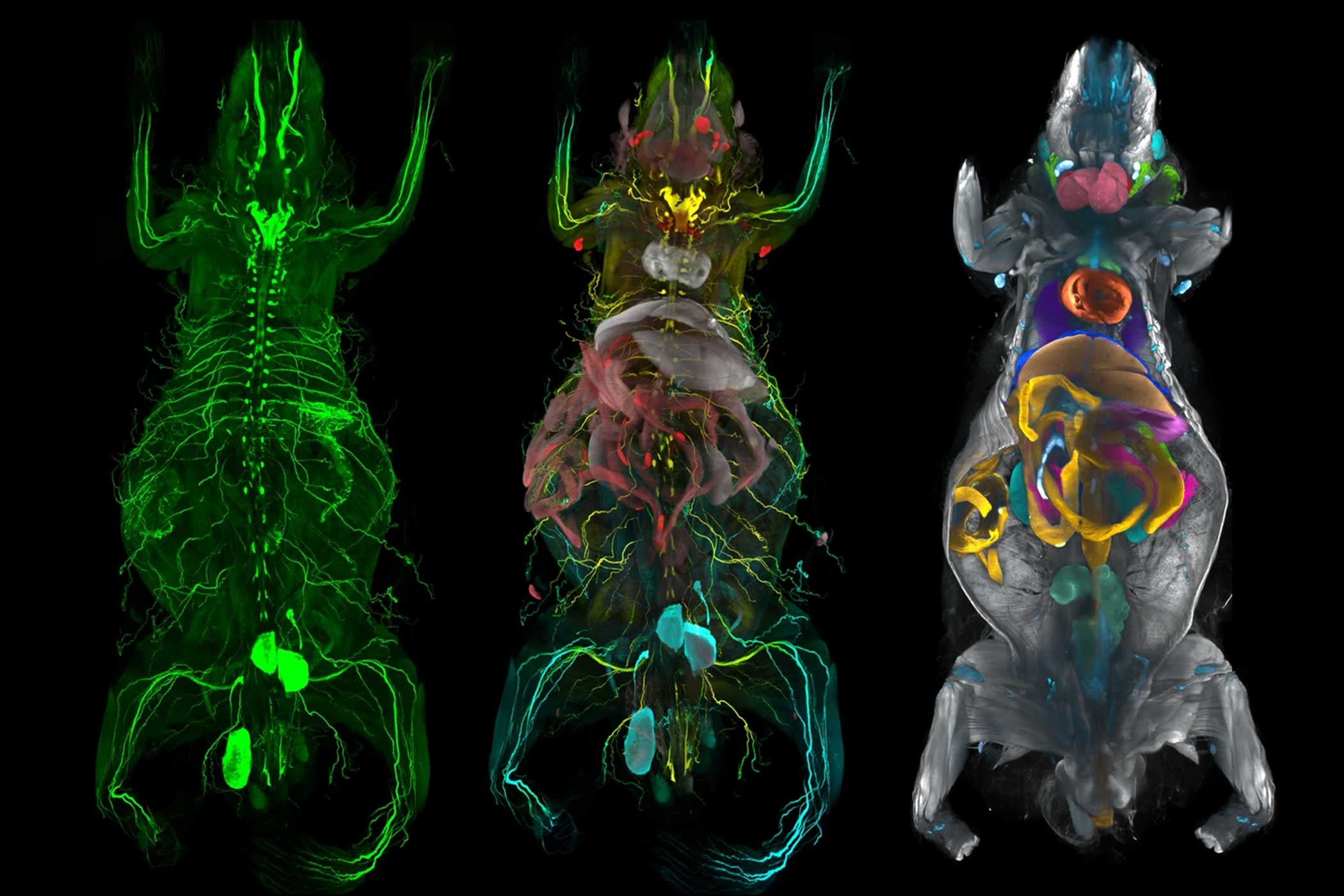
Erturk Lab

Obesity affects far more than metabolism, altering immune activity, nerve structure, and tissue organization across multiple organs. To study these effects, researchers developed MouseMapper, an AI framework that analyzes whole-body imaging data in intact mice at cellular resolution. Using fluorescent labeling, tissue clearing, and light-sheet microscopy, the team mapped nerves and immune cells throughout the body. In obese mice, they found widespread inflammation and significant damage to the trigeminal nerve, which controls facial sensation. The affected mice also showed reduced sensory responses. Molecular analysis revealed obesity-related changes linked to nerve remodeling and inflammation, many of which were also found in human tissue. The findings suggest obesity-associated nerve damage is conserved across species and demonstrate MouseMapper’s potential for studying complex systemic diseases.

Kaltenecker D, Horvath I, Al-Maskari R, Chen Y, Kolabas ZI, Hoeher L, Todorov M, Minde DP, Kapoor S, Turhan SG, Kuemmerle LB, Steinke H, Wohlgemuth T, Ali M, Kofler F, Morigny P, Geppert J, Jeridi D, Wittmann B, Luo J, Shit S, Cigankova C, Kolenic VM, Gür N, Aydeniz E, Yücecan A, Ertürk M, Simons LHA, Pan C, Piraud M, Rueckert D, Rohm M, Hellal F, Elsner M, Bhatia HS, Bechmann I, Menze BH, Herzig S, Paetzold JC, Diaz MB, Ertürk A. A deep-learning framework reveals whole-body perturbations at cell level. Nature. 2026 May 20. doi: 10.1038/s41586-026-10535-2. Epub ahead of print. PMID: 42162424.

Contact

Institute for Stroke and Dementia Research (ISD)
University Hospital, LMU Munich

Director: Prof. Dr. med. Martin Dichgans

Feodor-Lynen-Straße 17
81377 Munich, Germany

Phone: +49 (0)89 4400 46019
www.isd-research.de

Send a Mail

Partners

Neurologische Klinik und Poliklinik der Universität München, LMU Klinikum

DZNE – Deutsches Zentrum für Neurodegenerative Erkrankungen

SyNergy – Munich Cluster for Systems Neurology

Links

  • Our Labs
  • News
  • Publications
  • Open Positions
  • ISD for Patients
  • How to get there
  • Imprint
Editor login
  • Contact
  • Imprint
  • Privacy Policy
2026 © Institute for Stroke and Dementia Research (ISD)